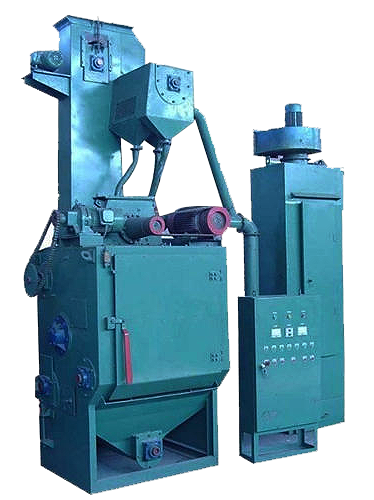
BASANT Mechanical Works' Turn Table Type Shot Blasting Machine is engineered for efficient, thorough surface cleaning, descaling, deburring, and surface preparation of heavy, large, or fragile components that cannot be tumbled. The component is placed on a rotating turntable inside the blast cabinet; as the table rotates, the high-velocity shot stream from fixed, precisely aimed turbines covers all exposed surfaces uniformly — delivering a consistently clean, prepared surface ideal for painting, coating, or inspection.
The turn table design is the preferred choice for heavy castings, large forgings, welded fabrications, gear housings, engine blocks and any component where part-on-part contact during tumbling would cause damage or dimensional distortion. Available in table diameter sizes from 500 mm to 2500 mm with batch capacities from 200 kg to 5000 kg.

Key Specifications at a Glance
Both are shot blasting machines — but the right type depends on your component's size, weight, fragility, and shape. The table below helps you choose.
| Parameter | Turn Table Type | Tumble Type |
|---|---|---|
| Component Handling | Placed stationary on rotating table | Tumbles freely in rubber belt barrel |
| Ideal Component Size | Medium to Very Large / Heavy | Small to Medium |
| Fragile / Precise Parts | Yes — no part-on-part contact | No — parts tumble together |
| Batch Loading | Individual or small batch | Bulk batch loading |
| Typical Component Types | Engine blocks, gear housings, large castings, weld fabrications | Small castings, fasteners, small forgings |
| Surface Coverage | All exposed surfaces (component may be repositioned for full coverage) | All surfaces via tumble action |
| Throughput | Lower — single or small batch | Higher — continuous bulk |
| Automation Potential | High — robot arm loading / overhead crane | Medium — conveyor feeding |
The component is placed on the rotating turntable — by hand, forklift, or overhead crane — and the blast cabinet door is closed and sealed.
The turntable starts rotating at a preset speed (adjustable via VFD), continuously presenting all faces of the component to the shot stream.
Centrifugal turbines throw high-velocity steel shot or grit at the component surface, removing scale, rust, sand, and contamination efficiently.
Used shot is conveyed back, cleaned in the separator, and recirculated. The cabinet opens and the clean component is unloaded ready for the next process.
Robust steel turntable with anti-wear surface liner and precision drive mechanism handles heavy components — from 200 kg to 5000 kg — without deflection or drive instability during the full blast cycle.
Table rotation speed is fully adjustable via variable frequency drive, allowing optimisation for different component geometries — slowing for complex shapes needing longer dwell, accelerating for simple profiles.
Precision-balanced centrifugal shot turbines deliver high-velocity abrasive at controlled blast angles. Multiple turbine configurations available for 360° coverage of complex component geometries.
Unlike tumble-type machines, the turn table design keeps each component stationary relative to others — eliminating damage to machined surfaces, precision features, thin walls, or brittle cast components.
The entire blast chamber is lined with replaceable manganese steel or rubber wear liners — protecting the cabinet structure from abrasive wear and extending service life significantly.
Integrated screw or belt conveyors, bucket elevator, rotary separator, and abrasive storage hopper continuously clean and recirculate shot — minimising abrasive consumption and operating cost.
A powerful cartridge filter dust collection unit maintains negative pressure inside the cabinet, capturing fine dust and broken abrasive particles and keeping the workshop environment clean and safe.
Fully automated PLC control with programmable blast time, table rotation speed, turbine on/off sequencing, and fault diagnostics — enabling repeatable, documented blast cycles for quality control.
Heavy-duty models feature roof access openings or wide front doors to allow overhead crane or forklift loading of very large or heavy components that cannot be manually handled.
Automotive
Heavy Engineering
Foundry & Casting
Forging Industry
Railways
Oil & Gas
Aerospace
General Fabrication
Tell us your component size, weight & throughput requirement — we'll size the right machine for you.